Semi-Automatic Telegraph Keys - "Bugs"
Semi-automatic keys, often called "bugs", generate the "dits" of the Morse Code automatically by using a pendulum and spring mechanism connected to the left hand lever. The "dahs" are generated manually by the operator using the right hand lever. This innovation, that automatically generated the "dits," reduced arm and wrist fatigue for telegraph operators and increased sending speed and legibility.
Vibropolex Semi-Automatic Telegraph Keys - "Bugs"
The Vibroplex Company has been manufacturing semi-automatic, mechanical telegraph keys for over 100 years. Their founder, Horace G. Martin, invented this type of key sometime around 1902. Vibroplex is still in business today.

RSGB Vibroplex Centenary Key
To celebrate the Radio Society of Great Britain's's 100th Anniversary, this Centenary Key was limited to 250 individually numbered keys. It has a polished chrome mechanism with blue paddles, mounted on a heavy, special gold finish, base. This is complemented by a blue & gold plaque that has the Centenary logo, the production number and the owner’s callsign. [137]
To celebrate the Radio Society of Great Britain's's 100th Anniversary, this Centenary Key was limited to 250 individually numbered keys. It has a polished chrome mechanism with blue paddles, mounted on a heavy, special gold finish, base. This is complemented by a blue & gold plaque that has the Centenary logo, the production number and the owner’s callsign. [137]
McElroy Bugs

1938 McElroy Standard Model Mac Key
This is a 1938 Mac-Key. This semi-automatic mechanical bug is distinguished by the black "U" shaped bar that supports the contacts. This key has the factory 'standard" black crackle finish paint. It was built by McElroy Manufacturing Company, then located in Boston, Mass. It is in near perfect condition and it was obtained from the estate of my friend, fellow key collector, and author, Dave Ingram K4TWJ, (SK). For more. information on McElroy keys, visit my McElroy page. [096]
This is a 1938 Mac-Key. This semi-automatic mechanical bug is distinguished by the black "U" shaped bar that supports the contacts. This key has the factory 'standard" black crackle finish paint. It was built by McElroy Manufacturing Company, then located in Boston, Mass. It is in near perfect condition and it was obtained from the estate of my friend, fellow key collector, and author, Dave Ingram K4TWJ, (SK). For more. information on McElroy keys, visit my McElroy page. [096]
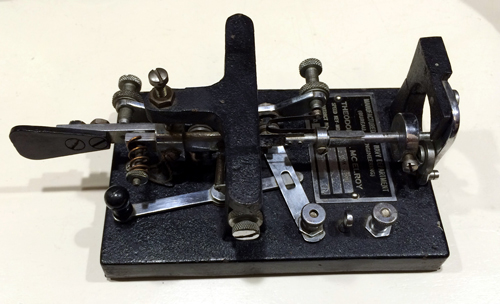
1936 - 1937 McElroy Speed Key Model CMK-26000 US Navy Contract
These bugs were manufactured by McElroy for the US Navy in 1936 and 1937. Only about 250 were made. Cast into the left side is the legend "PROPERTY OF US NAVY." Also listed on McElroy page. [143]
These bugs were manufactured by McElroy for the US Navy in 1936 and 1937. Only about 250 were made. Cast into the left side is the legend "PROPERTY OF US NAVY." Also listed on McElroy page. [143]

Telegraph Apparatus Company Model CP810 Bug
This semi-automatic telegraph key was manufactured by McElroy subsidiary company, Telegraph Apparatus Company in either 1944 or 1945. It has no date or serial number. It is known as the "Hole in the Wall" key, probably because of the two holes drilled in the base. It is a very long bug at just over 4 inches. The chrome plating is thin and prone to wearing off. [144]
This semi-automatic telegraph key was manufactured by McElroy subsidiary company, Telegraph Apparatus Company in either 1944 or 1945. It has no date or serial number. It is known as the "Hole in the Wall" key, probably because of the two holes drilled in the base. It is a very long bug at just over 4 inches. The chrome plating is thin and prone to wearing off. [144]